¶ WELCOME TO THE STEELDOME WIKI
One infrastructure operating system for storage, virtualization, containers, private cloud, AI, and HPC.
Welcome to the official SteelDome Wiki—the technical documentation and operations hub for StratiSYSTEM, StratiSTOR, StratiSERV, and HyperSERV.
SteelDome is built for infrastructure teams that need to modernize without replacing one form of lock-in with another. StratiSYSTEM provides a common software-defined operating foundation for compute, storage, networking, containers, acceleration, automation, observability, and infrastructure lifecycle management across supported industry-standard hardware.
Use this wiki to design, deploy, operate, expand, protect, troubleshoot, and optimize SteelDome environments—from a single node at the edge to enterprise clusters, private clouds, AI infrastructure, and geographically distributed deployments.
Start with the infrastructure you need today. Expand into the services you need tomorrow without changing the operating foundation underneath them.
¶ STRATISYSTEM: THE INFRASTRUCTURE OPERATING SYSTEM
At the center of SteelDome is StratiSYSTEM, the infrastructure operating system that powers the entire platform. It brings traditionally separate infrastructure domains together under a common deployment, management, monitoring, protection, and lifecycle model.
Rather than building separate operational silos for storage, virtualization, Kubernetes, private cloud, GPU infrastructure, high-performance networking, and edge services, organizations can deploy these capabilities on a shared foundation and activate the services appropriate for each environment.
The physical architecture remains flexible. StratiSYSTEM can support dedicated compute, dedicated storage, hyperconverged infrastructure, GPU-focused systems, external storage, edge nodes, and multi-site environments while preserving a consistent operating model across them.
Consistent where it matters. Open where choice matters.
¶ THE STEELDOME PLATFORM
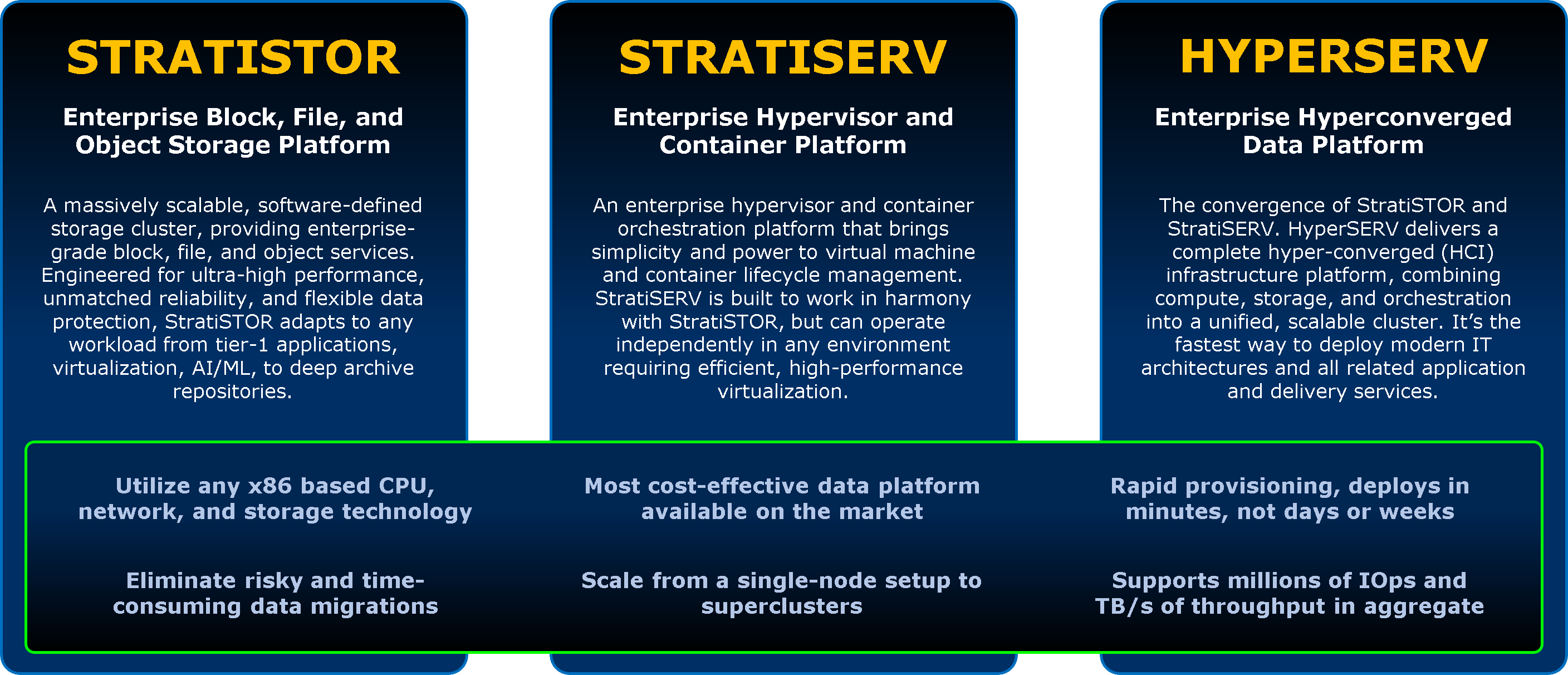
StratiSTOR is the software-defined data-services layer of StratiSYSTEM. It provides scalable block, file, object, and high-performance storage services using the media and hardware architecture appropriate for the workload. StratiSTOR supports environments ranging from enterprise virtualization and databases to backup, analytics, AI datasets, media, research, and multi-site data protection.
StratiSERV is the compute and workload-services layer of StratiSYSTEM. It provides enterprise virtualization, Kubernetes, containers, workload orchestration, high availability, live migration, backup and recovery, GPU infrastructure, advanced networking, automation, and centralized lifecycle management.
HyperSERV combines StratiSERV compute with StratiSTOR data services on the same nodes to deliver hyperconverged infrastructure under a common operational model. HyperSERV is designed for enterprise virtualization, private cloud, Kubernetes, AI, VDI, edge computing, databases, and mixed-workload consolidation while retaining the flexibility to integrate dedicated compute or storage resources as requirements evolve.
¶ BUILT FOR WHAT INFRASTRUCTURE HAS BECOME
Modern infrastructure is no longer defined by a single workload or architecture. Virtual machines coexist with Kubernetes. AI workloads compete for GPU, network, and storage bandwidth. Data continues to grow while applications spread across core data centers, edge locations, private clouds, and multiple sites. At the same time, infrastructure teams are being asked to reduce cost, automate more operations, and regain control over hardware and software decisions.
SteelDome is designed around those realities.
| Virtualization Modernization | Modernize legacy hypervisor and HCI environments with enterprise virtualization, high availability, migration, workload protection, flexible storage, and hardware independence. |
| Cloud-Native Infrastructure | Run virtual machines and Kubernetes-based applications from the same infrastructure foundation. Red Hat OpenShift can also be deployed on top of StratiSYSTEM when broader application-platform capabilities are required. |
| AI and Accelerated Computing | Build GPU-enabled infrastructure using supported NVIDIA and AMD technologies, GPU passthrough, virtual GPU capabilities, GPUDirect, DOCA, BlueField DPUs, high-speed networking, and scalable data services. |
| High-Performance Data | Support NVMe, NVMe-oF, high-throughput block, file and object services, Lustre, metadata-intensive workloads, and data pipelines requiring sustained throughput and low latency. |
| Accelerated Networking | Design around 25/100/200/400/800GbE, RDMA/RoCE, InfiniBand-oriented fabrics, SR-IOV, DPDK, VPP, OVN, overlays, QoS, and supported hardware-offload technologies. |
| Private and Sovereign Infrastructure | Operate private cloud, virtualization, storage, Kubernetes, and AI services under direct organizational control, including air-gapped and tightly controlled environments. |
| Distributed and Multi-Site Operations | Extend a common operating model across sites while designing for replication, disaster recovery, synchronous protection, workload mobility, data locality, and geographic resilience. |
¶ WHY STEELDOME
Traditional infrastructure often ties software capability to fixed hardware platforms, separate management stacks, complex licensing models, and disruptive refresh cycles. SteelDome takes a different approach: keep the operating foundation consistent while allowing the hardware, topology, and enabled services to evolve.
| Hardware Freedom | Build on supported industry-standard Intel and AMD x86 infrastructure and select storage media, network adapters, GPUs, DPUs, and accelerators according to workload requirements. |
| One Operating Foundation | Use common deployment, management, monitoring, automation, protection, and lifecycle patterns across storage, compute, HCI, Kubernetes, AI, edge, and private cloud infrastructure. |
| Composable Architecture | Deploy dedicated compute, dedicated storage, hyperconverged infrastructure, or hybrid combinations rather than forcing every workload into the same physical design. |
| Scale Without Architectural Reset | Add compute, capacity, network bandwidth, GPUs, or complete nodes as requirements grow. Introduce newer hardware generations without replacing the broader operating platform. |
| Automation and Observability | Use centralized health and performance visibility, APIs, scripting, service activation, and repeatable workflows to simplify day-2 operations and integrate infrastructure into broader operational systems. |
| Lifecycle Independence | Reduce dependence on forklift infrastructure refreshes. Workloads, data, and the operating model can remain in place while physical resources are expanded, modernized, or retired over time. |
¶ COMMON SOLUTION PATTERNS
| VIRTUALIZATION MODERNIZATION | Transition from legacy virtualization and HCI platforms to StratiSERV or HyperSERV with enterprise VM lifecycle management, high availability, live migration, backup, flexible storage, and modern networking. |
| ENTERPRISE PRIVATE CLOUD | Build private infrastructure with multitenancy, RBAC, automation, APIs, Kubernetes, OpenStack integration, software-defined networking, and scalable compute and storage services. |
| HYPERCONVERGED INFRASTRUCTURE | Use HyperSERV to combine StratiSERV compute and StratiSTOR data services on the same nodes while retaining the ability to add dedicated resources when compute and storage growth diverge. |
| SOFTWARE-DEFINED STORAGE | Replace aging SAN, NAS, or isolated storage silos with scalable StratiSTOR block, file, object, and high-performance data services using the hardware and media appropriate for each workload. |
| AI AND GPU INFRASTRUCTURE | Combine GPU-enabled compute, high-speed networking, scalable storage, Kubernetes, GPUDirect, supported DPU technologies, and AI data services for training, inference, analytics, and accelerated applications. |
| HPC AND RESEARCH | Support simulation, scientific computing, analytics, rendering, and throughput-intensive workloads using scalable compute, Lustre, high-performance storage, GPUs, and modern network fabrics. |
| KUBERNETES AND CLOUD-NATIVE | Operate Kubernetes infrastructure alongside enterprise virtual machines while sharing the same underlying compute, storage, network, monitoring, and lifecycle foundation. |
| VDI | Deploy centrally managed virtual desktops with workload protection, scalable storage, flexible resource allocation, data-loss-prevention strategies, and GPU acceleration where required. |
| EDGE AND ROBO | Run compact infrastructure at branch offices, industrial sites, laboratories, telecommunications locations, and remote facilities while maintaining the same StratiSYSTEM operating model used in the core data center. |
| DISASTER RECOVERY AND MULTI-SITE | Design for site resilience using workload protection, replication, multi-site data placement, synchronous protection where required, and recovery workflows aligned with application RPO and RTO objectives. |
| SERVICE PROVIDER AND MULTI-TENANT CLOUD | Deliver shared managed services or dedicated private environments using tenant isolation, RBAC, APIs, automation, scalable compute, storage, networking, Kubernetes, and GPU infrastructure. |
| AIR-GAPPED AND SOVEREIGN INFRASTRUCTURE | Operate virtualization, storage, Kubernetes, private cloud, and AI services in disconnected or tightly controlled environments using locally managed infrastructure and offline software repositories. |
¶ FROM EDGE TO ENTERPRISE TO AI
StratiSYSTEM is designed to remain consistent as the infrastructure around it changes. A compact edge deployment can use the same fundamental operating model as a larger enterprise cluster. A virtualization environment can grow into private cloud or Kubernetes. A conventional compute cluster can add GPUs and high-speed networking as AI requirements emerge. Storage can expand independently, or compute and storage can converge through HyperSERV.
That flexibility is intentional. The objective is not to force every application into one architecture. The objective is to provide one infrastructure operating foundation capable of supporting the architectures applications actually require.
¶ USE THIS WIKI TO BUILD AND OPERATE STRATISYSTEM
This documentation is intended for infrastructure architects, administrators, operators, engineers, partners, and service providers working with SteelDome technologies. It includes platform architecture, installation and deployment guidance, configuration procedures, operational workflows, networking, storage, virtualization, Kubernetes, high availability, data protection, troubleshooting, performance optimization, maintenance, and advanced deployment topics.
If you are evaluating the platform, begin with the StratiSYSTEM overview and features documentation. If you are deploying storage, continue with StratiSTOR. For virtualization and compute services, use the StratiSERV documentation. For integrated compute and storage, use HyperSERV. Advanced sections cover multi-site architecture, AI and GPU infrastructure, networking, automation, and other specialized deployments.
¶ BUILD INFRASTRUCTURE AROUND THE WORKLOAD—NOT THE LIMITATIONS OF THE PLATFORM
The technologies underneath modern infrastructure will continue to change. Processor generations will advance. Networks will become faster. Storage media will increase in performance and density. GPUs and DPUs will become increasingly important. Application architectures will continue to evolve.
StratiSYSTEM is designed so those changes do not require organizations to repeatedly start over.
Deploy what you need. Scale what matters. Change the hardware. Add new services. Keep the operating foundation.