¶ INTRODUCTION TO THE STRATISYSTEM OPERATING SYSTEM
StratiSYSTEM is the universal infrastructure operating system that forms the software foundation of the SteelDome platform. It powers StratiSTOR, StratiSERV, and HyperSERV, bringing storage, virtualization, containers, Kubernetes, networking, automation, monitoring, and infrastructure lifecycle management together under a common operating model.
Designed for modern data-centric infrastructure, StratiSYSTEM transforms industry-standard hardware into a flexible software-defined platform for compute, storage, cloud-native services, AI, and high-performance workloads. Rather than forcing infrastructure into a fixed appliance architecture, StratiSYSTEM allows organizations to select the hardware, topology, services, and scale appropriate for their applications while maintaining a consistent operational foundation.
This approach helps organizations address many of the challenges facing modern infrastructure teams: rapidly increasing data volumes, virtualization modernization, AI and GPU adoption, cloud-native application growth, high-speed networking requirements, infrastructure sprawl, operational complexity, hardware lifecycle management, and the need to deploy services across core data centers, edge locations, private clouds, and multiple sites.
StratiSYSTEM can support compact single-node environments, independent storage or compute clusters, disaggregated architectures, hyperconverged infrastructure, private cloud deployments, AI and HPC systems, and large distributed multi-site environments. The same fundamental operating model can therefore be maintained as infrastructure requirements evolve.
Rather than treating storage, virtualization, networking, containers, and infrastructure management as separate operational silos, StratiSYSTEM brings these capabilities together into a cohesive infrastructure platform designed around common deployment, management, monitoring, automation, protection, and lifecycle workflows.
StratiSYSTEM is delivered through three primary product roles:
STRATISTOR: A software-defined storage platform providing scalable block, file, and object services for enterprise applications, virtualization, databases, backup, private cloud, AI datasets, and other data-intensive workloads. StratiSTOR supports scale-out architectures, multiple protection models, high-performance data paths, and integration with modern Ethernet, RDMA-oriented, and high-speed storage environments.
STRATISERV: An enterprise virtualization, container, and compute platform for virtual machines, Kubernetes, application infrastructure, GPU-enabled workloads, and modern compute services. StratiSERV provides workload lifecycle management, high availability, migration, backup, networking, hardware passthrough, virtual GPU capabilities, automation, and centralized infrastructure management.
HYPERSERV: A hyperconverged infrastructure platform combining StratiSERV compute with StratiSTOR data services on the same nodes. HyperSERV provides an integrated operational model for environments that want compute and storage to scale together while maintaining the flexibility of the broader StratiSYSTEM architecture.
Together, these product roles allow organizations to deploy storage and compute independently, combine them in a hyperconverged architecture, or build mixed environments in which services are positioned according to workload, performance, availability, and operational requirements.
¶ WHY STRATISYSTEM
Traditional infrastructure platforms often bind software capabilities to proprietary hardware, fixed appliance configurations, separate management systems, and disruptive refresh cycles. As environments grow, this can create isolated infrastructure stacks for virtualization, storage, containers, AI, HPC, edge computing, and private cloud services—each with its own operational model.
StratiSYSTEM takes a different approach. The infrastructure operating system becomes the consistent layer, while the underlying hardware and enabled services can evolve over time. Organizations can standardize deployment, management, monitoring, networking, automation, and lifecycle processes without requiring every workload to use the same physical architecture.
This separation between the operating platform and the underlying hardware provides greater freedom during technology refreshes, capacity expansion, workload modernization, and architecture changes. Compute, storage, networking, GPU resources, and infrastructure services can be expanded or modified according to business requirements rather than the limitations of a predefined appliance model.
The result is an infrastructure platform designed to reduce silos while preserving choice: consistent where operational consistency matters, and flexible where workload requirements demand it.
¶ BUILT FOR MODERN INFRASTRUCTURE CHALLENGES
Modern infrastructure is being reshaped by several major changes occurring simultaneously. Organizations are modernizing traditional virtualization platforms, deploying Kubernetes and cloud-native services, introducing GPU-accelerated applications, processing increasingly large datasets, adopting 100GbE and faster networks, expanding infrastructure across multiple locations, and attempting to automate more of the infrastructure lifecycle.
StratiSYSTEM is designed to provide a common foundation across these environments rather than requiring a separate infrastructure stack for each workload type.
Virtualization Modernization
Run enterprise virtual machines on StratiSERV with clustering, high availability, live migration, snapshots, backup and recovery, shared storage, GPU capabilities, and centralized lifecycle management. Integrated migration capabilities help organizations transition workloads from existing virtualization environments while maintaining operational continuity.
Cloud-Native Infrastructure
Run virtual machines, containers, and Kubernetes infrastructure from the same platform. Kubernetes is available with StratiSERV, while platforms such as Red Hat OpenShift can be deployed on top of StratiSYSTEM when broader application-platform capabilities are required.
AI and GPU Infrastructure
Support AI training, inference, analytics, simulation, and other accelerated workloads using NVIDIA and AMD GPU technologies, GPU passthrough, supported virtual GPU capabilities, high-throughput StratiSTOR data services, and modern high-speed network architectures. NVIDIA DOCA and BlueField technologies can also be incorporated into supported configurations for DPU-accelerated infrastructure.
High-Performance Computing and Data-Intensive Workloads
Combine high-speed networking, GPU-enabled compute, StratiSTOR storage, and Lustre parallel data services to support research, simulation, scientific computing, analytics, rendering, AI pipelines, and other workloads requiring sustained data throughput.
High-Speed and Accelerated Networking
Support modern Ethernet and high-performance fabrics using technologies such as 25/100/200/400/800GbE, RDMA/RoCE, InfiniBand, SR-IOV, DPDK, VPP, VLAN, VxLAN, OVN, and hardware offload capabilities. VPP provides an accelerated vector packet-processing data path for workloads and infrastructure services that benefit from very high packet-processing throughput and reduced networking overhead.
Private and Sovereign Infrastructure
Deploy private cloud, Kubernetes, AI, storage, and virtualization services within infrastructure that remains under organizational control. StratiSYSTEM can also support disconnected and air-gapped environments using local services and offline software repositories where external connectivity is restricted or prohibited.
Distributed and Multi-Site Operations
Extend a common infrastructure model across data centers, edge sites, service-provider environments, and geographically distributed locations. Depending on the deployed services and architecture, StratiSYSTEM can support high availability, replication, disaster recovery, synchronous data protection, and multi-site infrastructure designs.
¶ HOW STRATISYSTEM DELIVERS VALUE
Scale-Out Growth
Start with the infrastructure required today and expand compute, storage, networking, and services as requirements grow. StratiSYSTEM supports architectures ranging from compact deployments to large distributed clusters designed for substantial capacity, throughput, and workload density.
Hardware Freedom
Deploy on supported industry-standard Intel and AMD x86 infrastructure rather than being restricted to a proprietary appliance lifecycle. Select processors, memory, NVMe, SSD, HDD, networking, GPUs, and accelerators according to application requirements and organizational standards.
Composable Architecture
Deploy storage, compute, virtualization, Kubernetes, AI infrastructure, and other services independently or together. Build tiered, disaggregated, hyperconverged, edge, or multi-site architectures without changing the underlying StratiSYSTEM operating model.
Performance Across the Infrastructure Stack
Optimize infrastructure using high-speed NVMe, caching, metadata acceleration, GPU technologies, RDMA, SR-IOV, DPDK, VPP, high-speed Ethernet, InfiniBand-oriented fabrics, NUMA-aware design, and other workload-specific acceleration technologies where appropriate.
Integrated Resilience
Design infrastructure around disk, device, network, node, service, and site failure scenarios. StratiSYSTEM provides clustering, automated service recovery, distributed data protection, high availability, fault-domain-aware architectures, backup, and multi-site protection capabilities according to the services deployed.
Automation and API-Driven Operations
Use APIs, scripting, orchestration, service activation, and repeatable deployment workflows to reduce manual infrastructure administration and integrate StratiSYSTEM with existing operational processes.
Centralized Observability
Monitor infrastructure health, resource utilization, service state, performance, hardware conditions, cluster activity, and operational events across storage, compute, networking, and supported accelerator resources from a common management environment.
Operational Consistency
Apply common deployment, monitoring, protection, upgrade, expansion, and lifecycle practices across different infrastructure architectures. This reduces the number of separate operational models infrastructure teams must maintain.
¶ KEY BENEFITS AT A GLANCE
- Deploy complete infrastructure services using repeatable, automated workflows rather than lengthy manual integration processes.
- Reduce dependence on proprietary hardware platforms and fixed appliance architectures.
- Scale compute and storage independently or together according to workload requirements.
- Support virtualization, containers, Kubernetes, private cloud, AI, HPC, and data services from a common infrastructure foundation.
- Provide block, file, object, VM, container, and high-performance data services across the same platform family.
- Take advantage of modern network acceleration including RDMA, SR-IOV, DPDK, VPP, high-speed Ethernet, and supported DPU technologies.
- Support GPU-enabled workloads and data-intensive AI infrastructure without introducing a separate operating model.
- Modernize infrastructure while preserving flexibility in hardware selection, deployment architecture, and workload placement.
- Expand infrastructure without requiring a complete architectural redesign as capacity and workload requirements change.
- Extend a common operational model across core data centers, edge locations, private clouds, AI infrastructure, and distributed environments.
- Use centralized monitoring, automation, APIs, and lifecycle management to reduce infrastructure complexity.
- Build infrastructure capable of adapting to new hardware, accelerators, networking technologies, and workload models over time.
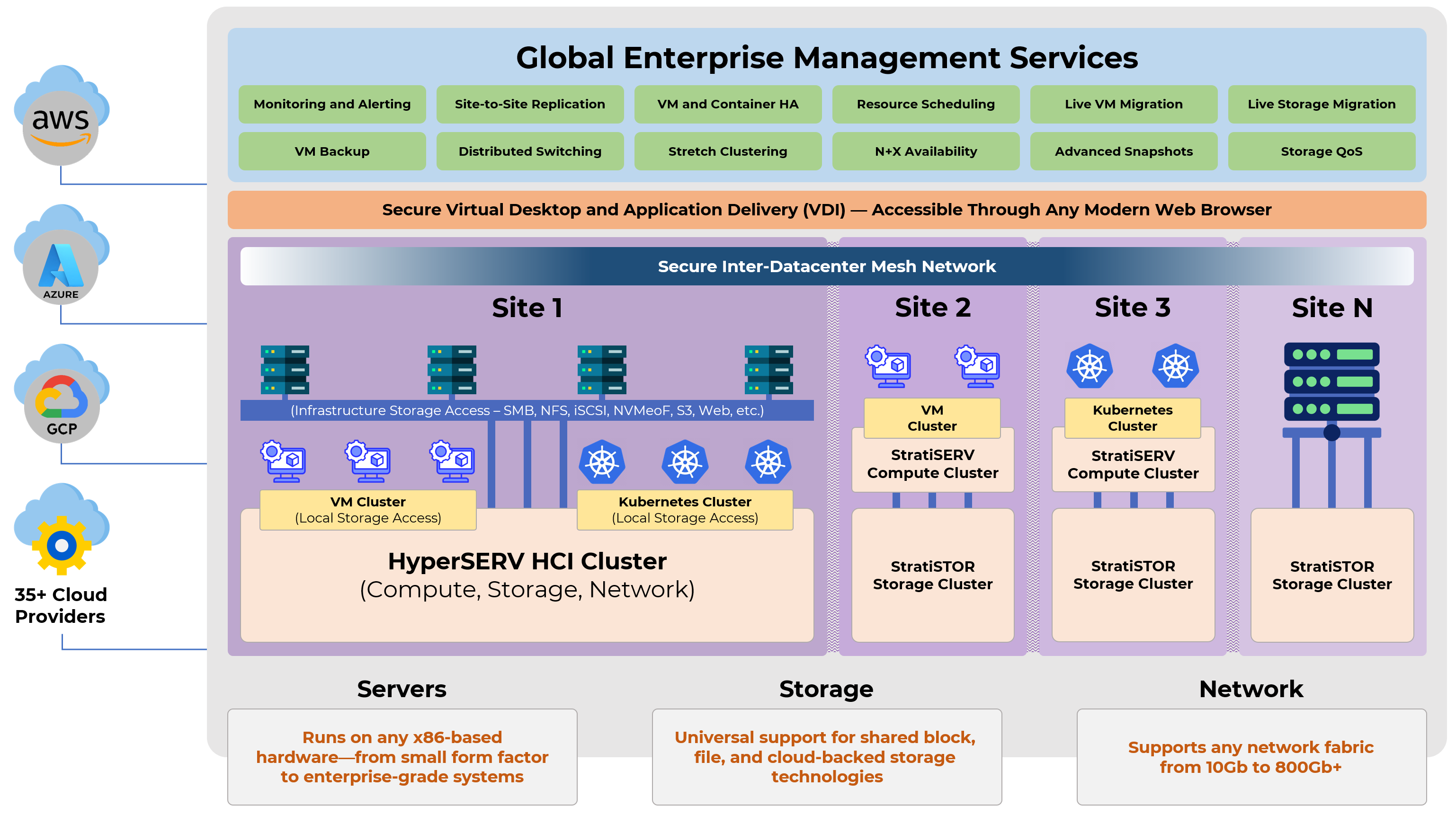
¶ ONE OPERATING FOUNDATION FROM EDGE TO DATA CENTER
Infrastructure requirements rarely remain static. Applications evolve, data volumes increase, new accelerator technologies emerge, network speeds increase, and organizations continuously introduce new workload models. Infrastructure platforms therefore need to support change without forcing complete platform replacement whenever requirements shift.
StratiSYSTEM is designed around this principle. The same software-defined foundation can be used for compact edge deployments, enterprise storage, virtualization clusters, hyperconverged systems, private clouds, Kubernetes environments, GPU infrastructure, HPC systems, and distributed multi-site deployments.
This allows infrastructure teams to maintain familiar operational workflows while changing the underlying scale, topology, hardware, and enabled services. Compute can grow independently from storage. Storage capacity can expand without replacing the compute layer. GPU resources can be introduced as AI requirements emerge. High-speed networking and accelerated data paths can be adopted as workloads demand additional performance.
The goal is not to force every workload into a single architectural pattern. The goal is to provide a common infrastructure operating system capable of supporting multiple architectural patterns without creating another collection of isolated infrastructure silos.
¶ A MODERN OPERATING SYSTEM FOR MODERN INFRASTRUCTURE
StratiSYSTEM is designed for organizations that need infrastructure to be more adaptable, scalable, observable, automated, and easier to operate. It provides the software-defined foundation required to modernize traditional data centers while also supporting emerging infrastructure requirements such as Kubernetes, AI, GPU acceleration, private cloud, high-performance storage, and high-speed networking.
By bringing storage, compute, virtualization, networking, data services, automation, and infrastructure lifecycle management under a common operating foundation, StratiSYSTEM helps reduce infrastructure fragmentation and provides a consistent path for modernization.
Organizations can adopt new technologies without abandoning existing workloads, scale individual infrastructure resources according to demand, and evolve deployment architectures over time while maintaining a consistent operational experience.
¶ IN SUMMARY
StratiSYSTEM is the infrastructure operating system behind the SteelDome platform. Through StratiSTOR, StratiSERV, and HyperSERV, it transforms industry-standard hardware into a software-defined foundation for storage, virtualization, containers, Kubernetes, hyperconverged infrastructure, private cloud, AI, HPC, and distributed infrastructure services.
Its value comes from combining infrastructure capabilities that are traditionally deployed as separate platforms while preserving the flexibility to choose how those capabilities are physically implemented. Storage and compute can be independent or converged. Workloads can run as virtual machines, containers, or cloud-native services. Infrastructure can range from a single node to large clusters and geographically distributed environments.
Whether the objective is to modernize an existing virtualization environment, build enterprise storage, deploy private cloud, support Kubernetes, introduce GPU and AI infrastructure, extend services to the edge, or create a scalable foundation for future growth, StratiSYSTEM provides a consistent operating platform designed to evolve with the infrastructure it manages.