¶ EXECUTIVE SUMMARY
StratiSERV is SteelDome’s software-defined compute and workload platform within StratiSYSTEM OS. It brings enterprise virtualization, Kubernetes, container services, private cloud, virtual desktops, and accelerated AI workloads onto a common infrastructure foundation.
Built for organizations modernizing VMware, Hyper-V, and other established virtualization environments, StratiSERV combines workload mobility, high availability, centralized administration, backup, replication, and automation without requiring a proprietary server appliance.
StratiSERV runs on supported industry-standard Intel and AMD x86 servers, with flexible choices for processors, memory, networking, GPUs, and storage. Compute can operate independently, connect to StratiSTOR or compatible third-party storage, or converge with StratiSTOR through HyperSERV.
The platform supports modern guest security, integrated Kubernetes, GPU passthrough and compatible vGPU technologies, and optional self-hosted AI inference services. This lets organizations modernize existing applications while introducing new workload models on the same operating foundation.
¶ SERVICE ARCHITECTURE
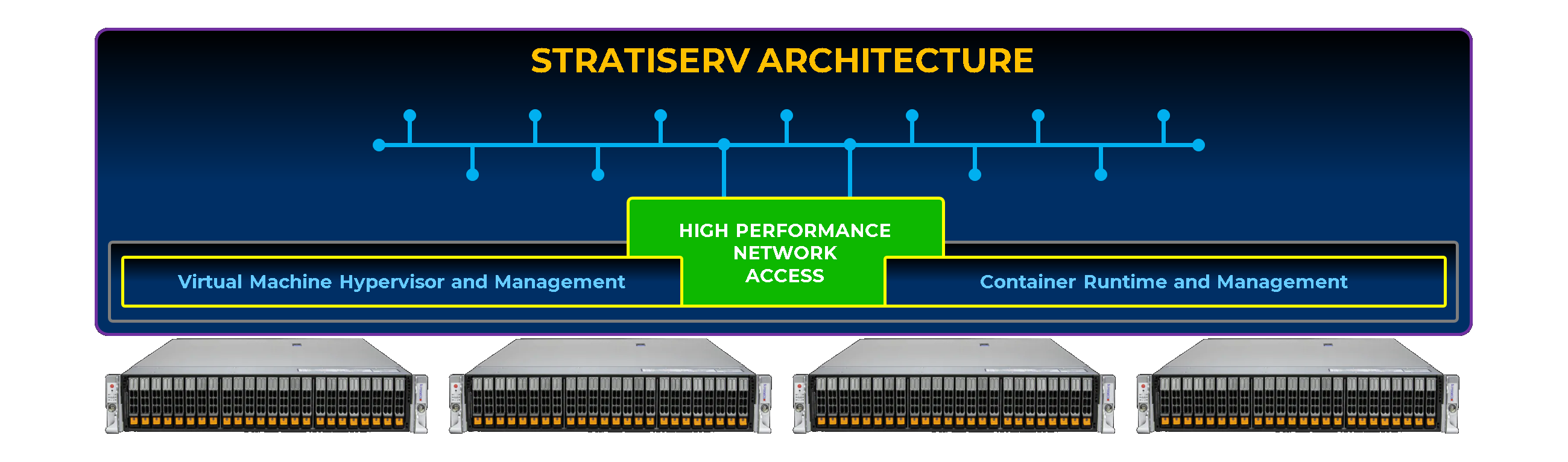
StratiSERV transforms supported physical server resources into centrally managed virtual-machine and container infrastructure. CPU, memory, virtual networking, shared storage, and selected hardware accelerators are allocated according to workload and availability requirements.
Its architecture separates compute services from the underlying hardware and from the storage design. Deployments can use dedicated StratiSERV clusters, StratiSTOR-backed compute, compatible external storage, or converged HyperSERV nodes.
The same management, protection, monitoring, and lifecycle model extends across small installations, enterprise compute clusters, GPU-enabled systems, and geographically distributed infrastructure.
¶ COMPUTE FOR MODERN INFRASTRUCTURE
Enterprise IT must now support established virtual machines, containers, Kubernetes, AI inference, private cloud, and edge services simultaneously. StratiSERV provides a common compute platform so organizations can add these capabilities without creating a separate infrastructure silo for each workload.
¶ VIRTUALIZATION MODERNIZATION
Organizations are reevaluating hypervisor cost, licensing, hardware constraints, and long-term infrastructure flexibility. StratiSERV offers an alternative based on industry-standard servers and enterprise functions such as high availability, live migration, storage migration, templates, snapshots, integrated backup, and VM replication.
Existing workloads can be transitioned in planned stages, while storage and compute are modernized independently when the architecture allows.
¶ VIRTUAL MACHINES AND CLOUD-NATIVE WORKLOADS
Traditional business applications often remain in virtual machines while new services use Kubernetes. StratiSERV supports both under one infrastructure operating model, sharing hardware management, networking, monitoring, and supported persistent storage without requiring application rewrites.
¶ AI AND ACCELERATED COMPUTING
StratiSERV supports GPU-enabled infrastructure for model inference, training, analytics, visualization, scientific computing, and VDI. Compatible NVIDIA and AMD devices can be used through GPU passthrough or supported virtualization technologies; specialized designs may include high-speed storage, GPUDirect, and DPU acceleration.
Optional self-hosted AI services support local model serving on compatible CPU or GPU systems, a shared multi-model web interface, and retrieval-augmented knowledge workflows. Distributed CPU inference is available in supported multi-node configurations, with storage and resource planning matched to the model.
¶ INCREASING NETWORK PERFORMANCE REQUIREMENTS
Dense virtualization, Kubernetes, live migration, and GPU workloads place growing demands on east-west networks. StratiSERV supports high-speed Ethernet, VLAN and overlay designs, SR-IOV, RDMA/RoCE, DPDK, VPP, OVN, and supported hardware offloads.
The network path is selected for the workload: conventional Linux networking remains appropriate for many installations, while accelerated paths can be introduced where packet rate, latency, or CPU efficiency warrants them.
¶ DISTRIBUTED INFRASTRUCTURE
StratiSERV uses a consistent operational model from compact edge and branch deployments to clustered enterprise and service-provider environments. Site-specific availability, networking, and recovery policies can be applied without changing the underlying compute platform.
¶ SECURITY, ISOLATION, AND GOVERNANCE
Role-aware administration, workload isolation, virtual TPM, supported Secure Boot configurations, and hardware-assisted controls help secure shared infrastructure. Confidential-computing features such as Intel TDX and AMD SEV depend on compatible hardware and the validated guest configuration.
¶ PRIVATE AND SOVEREIGN INFRASTRUCTURE
StratiSERV enables private infrastructure under customer control, including environments that require local management, offline repositories, or restricted external connectivity. OpenStack and supported application platforms can be layered on the StratiSYSTEM foundation when self-service and broader cloud functions are needed.
¶ ADVANCED VIRTUALIZATION AND WORKLOAD SERVICES
StratiSERV unifies core VM lifecycle operations with workload protection, clustered availability, storage flexibility, GPU support, and Kubernetes services.
¶ CENTRALIZED VIRTUAL MACHINE LIFECYCLE MANAGEMENT
Administrators can create, configure, start, stop, monitor, migrate, protect, and retire virtual machines through the StratiSERV management interface. CPU, memory, disks, NICs, firmware, guest-security options, and supported assigned devices are managed within the same workflow.
¶ HIGH AVAILABILITY
Cluster high availability can restart protected virtual machines on suitable hosts when a node fails. Recovery depends on available capacity, cluster quorum, storage accessibility, and each workload’s placement constraints; a restart is not equivalent to uninterrupted execution.
¶ LIVE MIGRATION
Live migration moves running virtual machines between compatible hosts to support maintenance, workload distribution, and hardware replacement with limited application interruption. CPU compatibility, shared storage, networking, and directly assigned devices determine migration eligibility.
¶ PER-VM CPU COMPATIBILITY
Per-VM CPU compatibility profiles support migration between validated processor generations without imposing one global CPU baseline on every workload. Compatibility must be confirmed across the intended source and destination hosts.
¶ STORAGE LIVE MIGRATION
Storage migration moves VM disks between supported destinations while the VM remains operational, supporting storage refresh, capacity redistribution, and transitions between storage architectures. The available migration path depends on the selected storage backend and guest workload.
¶ VM TEMPLATES AND RAPID PROVISIONING
Reusable VM templates accelerate consistent deployment of enterprise applications, development environments, and virtual desktops. Standardized hardware and guest configurations reduce setup effort and configuration drift.
¶ VM SNAPSHOTS
VM snapshots provide point-in-time checkpoints for supported workloads, useful for changes, testing, and short-term rollback. Snapshots complement but do not replace independent backup and recovery copies.
¶ INTEGRATED BACKUP AND RECOVERY
StratiSERV provides image-level VM backup and recovery with multi-disk protection and configurable backup destinations. Operators can recover an entire workload or restore selected files from supported Linux and Windows guest filesystems.
Granular recovery can include supported encrypted guest volumes when the authorized recovery key and required filesystem capabilities are available. Recovery procedures remain sensitive to guest consistency, virtual hardware, and the protection of UEFI and virtual TPM state.
¶ UNIVERSAL VM REPLICATION
Scheduled VM replication supports copying protected workloads to configured recovery infrastructure for disaster recovery and controlled failover. Replication jobs can be managed, run on demand, and monitored through the StratiSERV workflow.
Destination handling and recovery actions are controlled to avoid unintentionally replacing an existing VM; replication targets and recovery expectations must be validated before production use.
¶ SHARED STORAGE INTEGRATION
StratiSERV can use StratiSTOR, HyperSERV data services, or compatible third-party block and file storage. Shared access enables eligible clustered mobility and HA operations while allowing compute and storage to grow or refresh independently.
¶ GPU AND ACCELERATED COMPUTE
GPU and accelerator infrastructure can be incorporated into StratiSERV for AI, visualization, engineering, research, and data-intensive applications, with placement and migration limits determined by the selected hardware and virtualization mode.
¶ GPU PASSTHROUGH
Dedicated assignment provides a supported VM with direct access to a physical GPU for performance-sensitive AI, rendering, engineering, and scientific workloads. Such assignments can restrict live migration and HA host choices.
¶ NVIDIA VIRTUAL GPU
Compatible NVIDIA vGPU configurations can share supported physical GPUs across multiple VMs for VDI, visualization, and AI applications, subject to the GPU model, host drivers, software compatibility, and applicable NVIDIA licensing.
¶ AMD GPU TECHNOLOGIES
Supported AMD ROCm configurations enable accelerated compute, while compatible AMD GPU virtualization options can provide shared or partitioned accelerator access where the platform and device support it.
¶ NVIDIA GPUDIRECT
GPUDirect-capable data paths may reduce intermediate CPU copies for supported GPU, network, and storage configurations. End-to-end compatibility must be validated for the specific workload rather than inferred from the presence of a GPU and fast NIC.
¶ GPU MONITORING
Supported GPUs expose inventory, utilization, health, and thermal data for operational visibility and accelerator capacity planning.
¶ KUBERNETES AND CLOUD-NATIVE INFRASTRUCTURE
Kubernetes is part of the StratiSERV compute foundation, allowing modern container services to coexist with enterprise virtual machines and use compatible networking and persistent storage resources.
¶ KUBERNETES INCLUDED WITH STRATISERV
StratiSERV includes Kubernetes infrastructure for container orchestration, enabling VMs and cloud-native applications to share an operating foundation with common hardware, networking, monitoring, and lifecycle practices.
¶ RED HAT OPENSHIFT SUPPORT
Red Hat OpenShift can be deployed on supported StratiSYSTEM infrastructure when organizations require its application and developer platform. Compute, networking, and persistent storage must be designed around the chosen OpenShift deployment model.
¶ MIXED VM AND CONTAINER INFRASTRUCTURE
Existing applications can remain virtualized while teams introduce container services incrementally. This avoids requiring every application to be rewritten as part of infrastructure modernization.
¶ ADVANCED NETWORKING
StratiSERV supports virtual and physical network designs for enterprise VMs, containers, distributed storage, tenant isolation, and high-speed workload traffic. Options include VLAN, VXLAN, Geneve, OVN, SR-IOV, RDMA/RoCE, DPDK, VPP, and supported NIC offload.
Physical network capacity, PCIe bandwidth, NUMA placement, queue configuration, and end-to-end MTU remain important for high-throughput deployments.
¶ VPP ACCELERATED PACKET PROCESSING
VPP offers an optional vectorized packet-processing path for selected high-throughput network services. It complements conventional Linux networking, DPDK, SR-IOV, and hardware offload rather than replacing every virtual network path.
¶ SR-IOV AND HARDWARE PASSTHROUGH
Compatible NICs and PCIe devices can expose physical hardware functions to workloads to reduce software overhead or meet application requirements. Device assignment affects mobility, isolation, and eligible recovery hosts.
¶ NETWORK ISOLATION AND SEGMENTATION
VLANs, virtual networks, overlays, routing policy, and access controls isolate management, storage, tenant, and application traffic in accordance with the deployment design.
¶ SECURITY AND WORKLOAD ISOLATION
StratiSERV combines role-aware administration, guest-security options, network segmentation, and supported hardware-assisted isolation to protect the management plane and hosted workloads.
¶ VIRTUAL TPM
Virtual TPM enables compatible guests, including modern Windows configurations, to use TPM-backed identity and key protection. Backup and recovery planning must account for the guest’s virtual TPM and UEFI state, not only virtual disks.
¶ CONFIDENTIAL COMPUTING
Intel TDX and AMD SEV can provide additional VM memory isolation on compatible hosts with an approved firmware, kernel, hypervisor, and guest configuration. Feature availability and mobility constraints are platform-specific.
¶ ROLE-BASED ACCESS AND MULTITENANCY
Administrative roles and resource separation support delegated operations across teams, business units, and service-provider tenants without granting every operator unrestricted infrastructure access.
¶ AUTOMATION, OBSERVABILITY, AND DAY-2 OPERATIONS
Centralized monitoring, API-driven workflows, protection jobs, and lifecycle management support repeatable operations across virtual machines and physical compute hosts.
¶ CENTRALIZED OBSERVABILITY
StratiSERV brings host and VM CPU/memory utilization, workload state, storage and network health, hardware telemetry, and supported GPU monitoring into one operational view, helping operators recognize capacity pressure and investigate failures.
¶ PERFORMANCE TRENDING AND CAPACITY PLANNING
Historical utilization and health trends help teams assess VM density, resource contention, growth, and the spare capacity required for maintenance and failure recovery.
¶ AUTOMATION AND APIS
Web administration, command-line tools, APIs, and repeatable task workflows support provisioning, policy enforcement, protection, monitoring, and integration with broader operations systems.
¶ MAINTENANCE AND LIFECYCLE MANAGEMENT
Live migration, workload protection, host maintenance operations, and supported rolling updates reduce planned disruption when cluster health, capacity, and device-placement constraints permit.
¶ INFRASTRUCTURE MODERNIZATION AND MIGRATION
Virtualization modernization involves more than changing hypervisors. Workload dependencies, operating systems, storage, networking, security, and recovery processes must transition together.
StratiSERV provides pathways for importing or migrating supported workloads from VMware, Hyper-V, and other environments. Its hardware-independent design allows compute and storage to be modernized in stages: retain compatible storage, introduce StratiSTOR independently, or converge through HyperSERV when appropriate.
¶ COMMON STRATISERV WORKLOADS
StratiSERV supports enterprise and emerging compute workloads across a range of physical deployment models.
¶ ENTERPRISE VIRTUALIZATION
Operate business-critical VMs with HA, migration, snapshots, multi-disk backup, file-level recovery, scheduled replication, shared storage, and centralized workload management.
¶ VIRTUALIZATION PLATFORM MODERNIZATION
Migrate supported workloads from legacy virtualization infrastructure while retaining flexibility in server, storage, network, and long-term lifecycle decisions.
¶ PRIVATE CLOUD
Provide an enterprise compute layer for private cloud, automation, multitenancy, Kubernetes, and supported OpenStack-based services.
¶ VIRTUAL DESKTOP INFRASTRUCTURE
Host centrally managed desktops with workload protection, policy-based access, and compatible GPU acceleration for graphics-intensive sessions where required.
¶ KUBERNETES AND APPLICATION PLATFORMS
Run Kubernetes alongside VMs with shared infrastructure operations and supported persistent storage for stateful applications.
¶ AI, MACHINE LEARNING, AND DATA SCIENCE
Run GPU-based AI workloads and optional local CPU/GPU inference services, including supported model serving, shared web access, and retrieval-augmented applications. Pair compute with StratiSTOR and high-speed networking where data movement is intensive.
¶ DEVELOPMENT, TEST, AND CI/CD
Provision repeatable virtual-machine and container environments for development, testing, software validation, and automation pipelines.
¶ SERVICE PROVIDER AND MULTI-TENANT INFRASTRUCTURE
Use tenant segmentation, role-aware administration, automation, APIs, and scalable resource pools for managed services and private customer environments.
¶ EDGE AND REMOTE INFRASTRUCTURE
Extend compute services to branches, industrial sites, laboratories, and remote facilities under the same StratiSYSTEM management model.
¶ DEPLOYMENT MODELS
StratiSERV supports dedicated, converged, hybrid, and distributed compute designs so infrastructure can be matched to workload density, availability objectives, and growth.
¶ SINGLE-NODE AND COMPACT DEPLOYMENTS
Single-node systems serve development, laboratories, edge locations, and other workloads without node-level compute HA requirements.
¶ DUAL-NODE DEPLOYMENTS
Two-node designs can reduce physical footprint for smaller environments when the required quorum, fencing, shared-storage, and recovery architecture is provided.
¶ MULTI-NODE COMPUTE CLUSTERS
Multi-node clusters increase available capacity, workload mobility, maintenance flexibility, and failure recovery options as nodes are added.
¶ TIERED AND DISAGGREGATED ARCHITECTURE
Dedicated StratiSERV compute clusters can use StratiSTOR or compatible third-party storage, allowing compute and capacity to grow independently.
¶ HYPERCONVERGED INFRASTRUCTURE
HyperSERV combines StratiSERV workloads and StratiSTOR distributed storage on the same nodes, aligning compute and storage management in a converged architecture.
¶ HYBRID ARCHITECTURE
Mix dedicated compute, HyperSERV, third-party storage, and GPU-oriented nodes to serve workloads with different performance, density, and availability requirements.
¶ MULTI-SITE AND STRETCH INFRASTRUCTURE
Multi-site deployments can combine StratiSERV compute and supported protected storage for geographic recovery or workload placement, with service behavior governed by the selected network, storage, and quorum design.
¶ DESIGNED FOR CONTINUOUS INFRASTRUCTURE EVOLUTION
Server generations, GPUs, networks, and application models continue to change. StratiSERV is designed to let organizations adopt these advances without replacing the entire compute operating model.
New nodes can extend CPU and memory capacity, compatible guests can migrate between validated hosts, storage can be refreshed independently, and accelerated compute can be introduced where workloads require it.
¶ CONCLUSION
StratiSERV is the software-defined compute foundation of StratiSYSTEM, combining enterprise virtualization, Kubernetes, GPU-capable infrastructure, advanced networking, workload protection, and centralized lifecycle management.
Its value goes beyond hypervisor replacement: organizations can modernize existing VMs, deploy cloud-native applications, operate private AI services, expand to the edge, and support distributed infrastructure with hardware choice and a consistent operating model.
Deploy StratiSERV independently, connect it to StratiSTOR or compatible external storage, or converge compute and storage through HyperSERV. The architecture can evolve as business requirements, hardware generations, and workload priorities change.